
Wells Fargo business online banking login & business services
Welcome
Sign on to manage your accounts.



Get help finding products and services for your business
Use our Product Selector to find options for your business needs
Why choose Wells Fargo?

Tailored
We provide personalized options by working with you to develop a deep, long-term understanding of your business.

Supportive
Our bankers have the knowledge to help you move your business forward — now and in the future.

Simple
We provide easy-to-use products, tools, and resources for small businesses to help simplify your financial life.
Bank almost anywhere business takes you
Small business resources

Get the right resources for right now
We're here to support you with tips, tools, and guidance to help your business thrive.

Prepare before you apply
Gather the documents you'll need to open a business checking account.


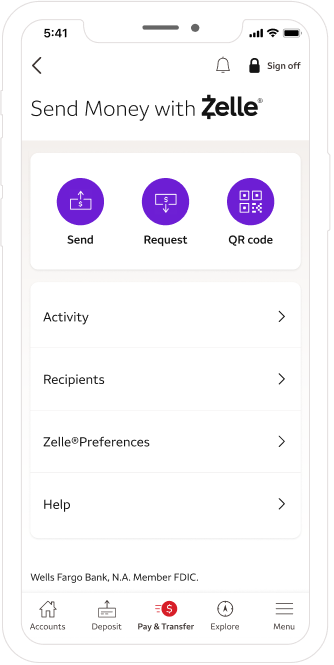
Enrollment with Zelle® through Wells Fargo Online® or Wells Fargo Business Online® is required. Terms and conditions apply. U.S. checking or savings account required to use Zelle®. Transactions between enrolled users typically occur in minutes. For your protection, Zelle® should only be used for sending money to friends, family, or others you trust. Neither Wells Fargo nor Zelle® offers purchase protection for payments made with Zelle® - for example, if you do not receive the item you paid for or the item is not described or as you expected. The Request feature within Zelle® is only available through Wells Fargo using a smartphone. Payment requests to persons not already enrolled with Zelle® must be sent to an email address. To send or receive money with a small business, both parties must be enrolled with Zelle® directly through their financial institution’s online or mobile banking experience. For more information, view the Zelle® Transfer Service Addendum to the Wells Fargo Online Access Agreement. Your mobile carrier's message and data rates may apply. Account fees (e.g., monthly service, overdraft) may apply to Wells Fargo account(s) with which you use Zelle®.
Sign-up may be required. Availability may be affected by your mobile carrier's coverage area. Your mobile carrier's message and data rates may apply.
Android, Chrome, Google Pay, Google Pixel, Google Play, Wear OS by Google, and the Google Logo are trademarks of Google LLC.
Apple, the Apple logo, Apple Pay, Apple Watch, Face ID, iCloud Keychain, iPad, iPad Pro, iPhone, iTunes, Mac, Safari, and Touch ID are trademarks of Apple Inc., registered in the U.S. and other countries. Apple Wallet is a trademark of Apple Inc. App Store is a service mark of Apple Inc.
Availability may be affected by your mobile carrier's coverage area. Your mobile carrier's message and data rates may apply.
Deposit products offered by Wells Fargo Bank, N.A. Member FDIC.
Merchant Services are provided by Wells Fargo Merchant Services L.L.C. and Wells Fargo Bank, N.A.
Wells Fargo Merchant Services L.L.C. does not offer deposit products, and its services are not guaranteed or insured by the FDIC or any other governmental agency. When you use a Wells Fargo Bank deposit account for settlement or other Merchant Services purposes, you must use a Wells Fargo Bank business or commercial deposit account. Deposit products offered by Wells Fargo Bank, N.A. Member FDIC. Merchant Services are subject to application, credit review of the business and its owners, and approval.
Zelle® and the Zelle® related marks are wholly owned by Early Warning Services, LLC and are used herein under license.
QSR-09262025-6507364.1.1
LRC-0324
